> For the complete documentation index, see [llms.txt](https://documentation.immuta.com/SaaS/llms.txt). Markdown versions of documentation pages are available by appending `.md` to page URLs; this page is available as [Markdown](https://documentation.immuta.com/SaaS/configuration/application-configuration/how-to-guides/private-networking-support/data-connection-private-networking/index/azure-privatelink.md).
# Azure Private Link for Databricks
Set up private connectivity between Immuta SaaS and Azure Databricks accounts
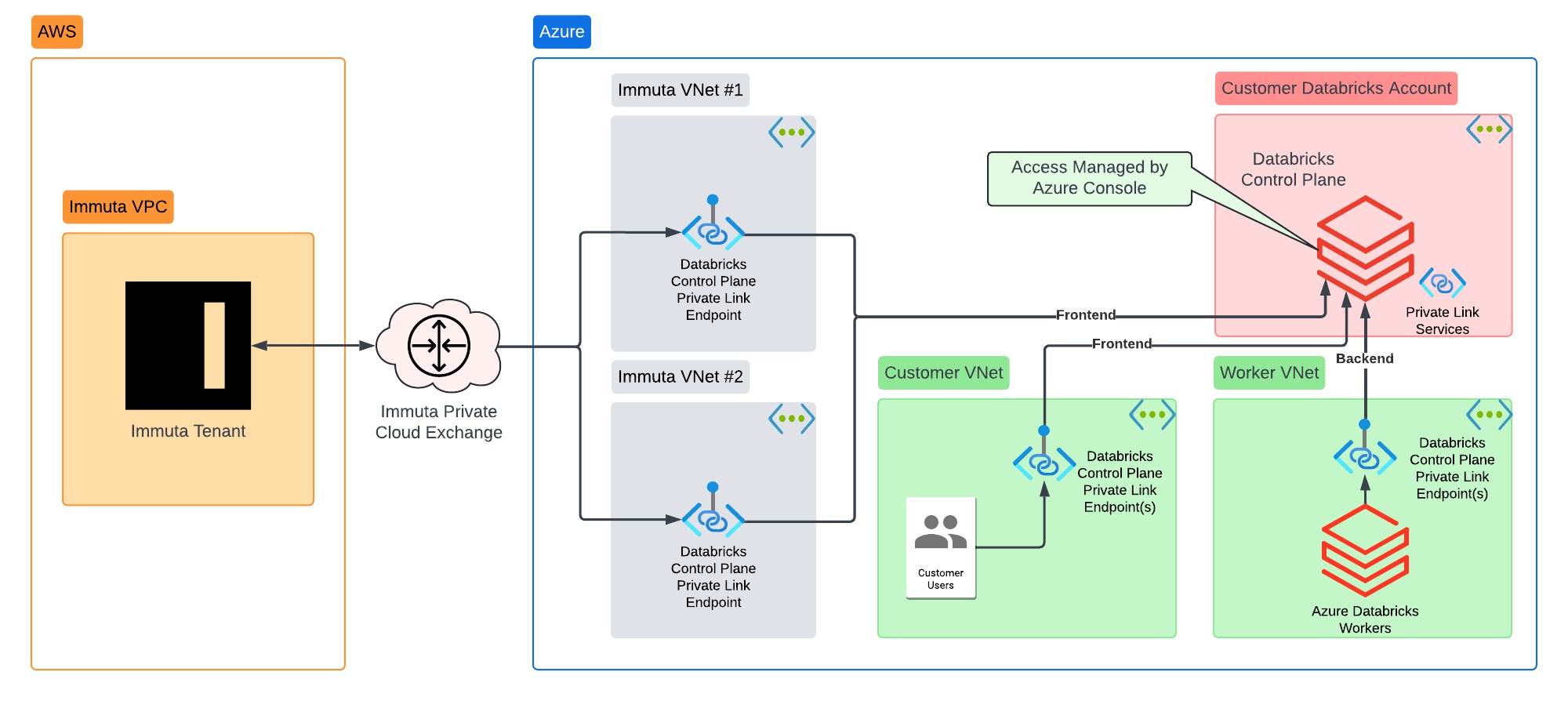
[Azure Private Link](https://learn.microsoft.com/en-us/azure/private-link/private-link-overview) provides private connectivity from the Immuta SaaS platform, hosted on AWS, to Azure Databricks accounts. It ensures that all traffic to the configured endpoints only traverses private networks over the Immuta Private Cloud Exchange.
This front-end Private Link connection allows users to connect to the Databricks web application, REST API, and Databricks Connect API over an Azure Private Endpoint. For details about Azure Private Link for Databricks and the network flow in a typical implementation, explore the [Databricks documentation](https://learn.microsoft.com/en-us/azure/databricks/security/network/classic/private-link).
Support for Azure Private Link is available in [all Databricks-supported Azure regions](https://learn.microsoft.com/en-us/azure/databricks/resources/supported-regions#--supported-regions-list).
## Requirements
Ensure that your accounts meet the following requirements:
* You have an Immuta SaaS tenant.
* Your Azure Databricks workspace must be on the [Premium or Enterprise pricing tier](https://www.databricks.com/product/pricing/platform-addons).
* [Azure Private Link for Databricks](https://learn.microsoft.com/en-us/azure/databricks/security/network/classic/private-link) has been configured and enabled.
* You have your Databricks account ID from the [account console](https://learn.microsoft.com/en-us/azure/databricks/admin/#--access-the-account-console).
## Configure Databricks with Azure Private Link
1. Contact your Immuta representative, and provide the following information for each Azure Databricks Workspace you wish to connect to:
* Azure region
* Azure Databricks hostname
* Azure Databricks resource ID or alias
2. Your representative will inform you when the two Azure Private Link connections have been made available. Accept them in your [Azure Databricks workspace configuration](https://learn.microsoft.com/en-us/azure/databricks/security/network/classic/private-link-standard#--check-for-pending-approval-or-approve-pending-private-endpoints).
3. Configure Databricks depending on your integration type:
1. [Configure the Databricks Unity Catalog integration](/SaaS/configuration/integrations/databricks/databricks-unity-catalog/how-to-guides/connect-unity-catalog.md) using your standard `cloud.databricks.com` workspace URL as the **Host**.
2. Configure the [Databricks Spark integration](/SaaS/configuration/integrations/databricks/databricks-spark/how-to-guides/simplified.md) using your standard `azuredatabricks.net` URL. And [register your tables as Immuta data sources](/SaaS/configuration/integrations/data-and-integrations/registering-metadata/register-data-sources/databricks-tutorial.md) using the `privatelink-account-url` from the JSON object in step one as the **Server** when registering data sources.
---
# Agent Instructions
This documentation is published with GitBook. GitBook is the documentation platform designed so that both humans and AI agents can read, navigate, and reason over technical content effectively. Learn more at gitbook.com.
## Querying This Documentation
If you need additional information that is not directly available in this page, you can query the documentation by asking a question.
Perform an HTTP GET request on the following URL with the `ask` and `goal` query parameters:
```
GET https://documentation.immuta.com/SaaS/configuration/application-configuration/how-to-guides/private-networking-support/data-connection-private-networking/index/azure-privatelink.md?ask=&goal=
```
`ask` is the immediate question: it should be specific, self-contained, and written in natural language.
`goal` is what the user is ultimately trying to achieve, the reason they need the answer. Sharing it helps GitBook give you a better, more relevant answer. A goal is most helpful when it describes the outcome the user wants rather than restating the question. For example, with `ask=how do I create an API token`, a goal like `automate deployments from our CI pipeline` lets GitBook tailor the answer to that use case.
The response will contain a direct answer to the question and relevant excerpts and sources from the documentation.
Use this mechanism when the answer is not explicitly present in the current page, you need clarification or additional context, or you want to retrieve related documentation sections.