> For the complete documentation index, see [llms.txt](https://documentation.immuta.com/saas/llms.txt). Markdown versions of documentation pages are available by appending `.md` to page URLs; this page is available as [Markdown](https://documentation.immuta.com/saas/~/changes/l3NnvynMHxi6VvqRtJhK/application-configuration/how-to-guides/private-networking-support/index-1/aws-privatelink.md).
# AWS PrivateLink for Snowflake
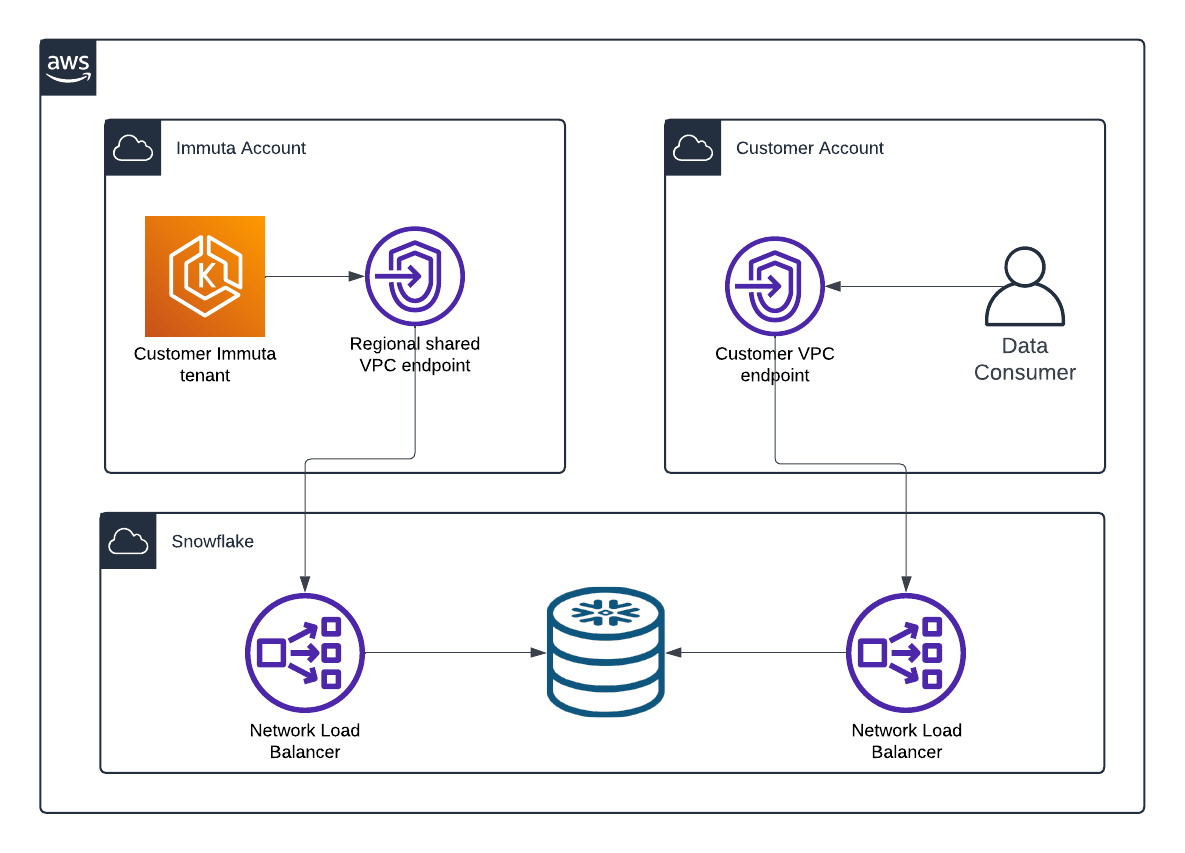
[AWS PrivateLink](https://docs.aws.amazon.com/vpc/latest/privatelink/what-is-privatelink.html) provides private connectivity from the Immuta SaaS platform to customer-managed Snowflake accounts hosted on AWS. It ensures that all traffic to the configured endpoints only traverses private networks.
This feature is supported in most regions across Immuta's Global Segments (NA, EU, and AP); contact your Immuta account manager if you have questions about availability.
## Requirements
* You have an Immuta SaaS tenant.
* Your Snowflake account is hosted on AWS.
* Your Snowflake account is on the [Business Critical Edition](https://docs.snowflake.com/en/user-guide/intro-editions#feature-edition-matrix).
* You have `ACCOUNTADMIN` role on your Snowflake account to configure the Private Link connection.
* You have enabled [AWS PrivateLink for Snowflake](https://docs.snowflake.com/en/user-guide/admin-security-privatelink.html).
## Configure Snowflake with AWS PrivateLink
1. In your Snowflake environment, run the following SQL query, which will return a JSON object with the connection information you will need to include in your support ticket:
```sql
select SYSTEM$GET_PRIVATELINK_CONFIG()
```
2. Copy the returned JSON object into a support ticket with [Immuta Support](https://support.immuta.com) to request for the feature to be enabled on your Immuta SaaS tenant.
3. [Configure the Snowflake integration](/saas/~/changes/l3NnvynMHxi6VvqRtJhK/integrations/snowflake/how-to-guides/enterprise.md).
4. [Register your tables as Immuta data sources](/saas/~/changes/l3NnvynMHxi6VvqRtJhK/data-and-integrations/registering-metadata/register-data-sources/snowflake-tutorial.md).
{% hint style="info" %}
Note that the `privatelink-account-url` from the JSON object in step one will be the **Server** when registering data sources.
{% endhint %}
---
# Agent Instructions
This documentation is published with GitBook. GitBook is the documentation platform designed so that both humans and AI agents can read, navigate, and reason over technical content effectively. Learn more at gitbook.com.
## Querying This Documentation
If you need additional information that is not directly available in this page, you can query the documentation dynamically by asking a question.
Perform an HTTP GET request on the current page URL with the `ask` query parameter, and the optional `goal` query parameter:
```
GET https://documentation.immuta.com/saas/~/changes/l3NnvynMHxi6VvqRtJhK/application-configuration/how-to-guides/private-networking-support/index-1/aws-privatelink.md?ask=&goal=
```
`ask` is the immediate question: it should be specific, self-contained, and written in natural language.
`goal` is optional and describes the broader end goal you are ultimately trying to accomplish on behalf of the user. GitBook uses it to tailor the answer towards what is most useful for that goal.
The response will contain a direct answer to the question and relevant excerpts and sources from the documentation.
Use this mechanism when the answer is not explicitly present in the current page, you need clarification or additional context, or you want to retrieve related documentation sections.