# Immuta Integrations

Immuta does not require users to learn a new API or language to access protected data. Instead, Immuta integrates with existing tools and ongoing work while remaining invisible to downstream consumers.

The following data platforms integrate with Immuta:

* [**Snowflake integration**](https://documentation.immuta.com/2024.2/data-and-integrations/snowflake/snowflake): With this integration, policies administered in Immuta are pushed down into Snowflake as [Snowflake governance features](https://docs.snowflake.com/en/user-guide/admin-governance.html) (row access policies and masking policies).
* **Databricks**:
  * [**Databricks Unity Catalog integration**](https://documentation.immuta.com/2024.2/data-and-integrations/databricks-unity-catalog/unity-catalog): This integration allows you to manage multiple Databricks workspaces through Unity Catalog while protecting your data with Immuta policies. Instead of manually creating UDFs or granting access to each table in Databricks, you can author your policies in Immuta and have Immuta manage and enforce Unity Catalog access-control policies on your data in Databricks clusters or SQL warehouse.
  * [**Databricks Spark integration**](https://documentation.immuta.com/2024.2/data-and-integrations/databricks-spark/reference-guides/databricks): This integration enforces policies on Databricks tables registered as data sources in Immuta, allowing users to query policy-enforced data on Databricks clusters (including job clusters). Immuta policies are applied to the plan that Spark builds for users' queries, all executed directly against Databricks tables.
* [**Google BigQuery**](https://documentation.immuta.com/2024.2/google-bigquery#overview): In this integration, Immuta generates policy-enforced views in your configured Google BigQuery dataset for tables registered as Immuta data sources.
* [**Starburst (Trino) integration**](https://documentation.immuta.com/2024.2/data-and-integrations/starburst-trino/trino): The Starburst (Trino) integration allows you to access policy-protected data directly in your Starburst (Trino) catalogs without rewriting queries or changing your workflows. Immuta policies are translated into Starburst (Trino) rules and permissions and applied directly to tables within users’ existing catalogs.
* [**Redshift integration**](https://documentation.immuta.com/2024.2/data-and-integrations/redshift/redshift): With the Redshift integration, Immuta applies policies directly in Redshift. This allows data analysts to query their data directly in Redshift instead of going through a proxy.
* [**Azure Synapse Analytics integration**](https://documentation.immuta.com/2024.2/data-and-integrations/azure-synapse-analytics/synapse): The Azure Synapse Analytics integration allows Immuta to apply policies directly in Azure Synapse Analytics dedicated SQL pools without needing users to go through a proxy. Instead, users can work within their existing Synapse Studio and have per-user policies dynamically applied at query time.
* [**Amazon S3 integration**](https://documentation.immuta.com/2024.2/data-and-integrations/amazon-s3): The Amazon S3 integration allows users to apply subscription policies to data in S3 to restrict what prefixes, buckets, or objects users can access. To enforce access controls on this data, Immuta creates S3 grants that are administered by S3 Access Grants, an AWS feature that defines access permissions to data in S3.

## Feature support

The table below outlines the features supported by each of Immuta's integrations.

<table><thead><tr><th width="138"></th><th width="99">Project workspaces</th><th>Tag ingestion</th><th>User impersonation</th><th>Query audit</th><th>Multiple integrations</th></tr></thead><tbody><tr><td>Snowflake</td><td><span data-gb-custom-inline data-tag="emoji" data-code="2705">✅</span></td><td><span data-gb-custom-inline data-tag="emoji" data-code="2705">✅</span></td><td><span data-gb-custom-inline data-tag="emoji" data-code="2705">✅</span></td><td><span data-gb-custom-inline data-tag="emoji" data-code="2705">✅</span></td><td><span data-gb-custom-inline data-tag="emoji" data-code="2705">✅</span></td></tr><tr><td>Databricks Unity Catalog</td><td><span data-gb-custom-inline data-tag="emoji" data-code="274c">❌</span></td><td><span data-gb-custom-inline data-tag="emoji" data-code="2705">✅</span></td><td><span data-gb-custom-inline data-tag="emoji" data-code="274c">❌</span></td><td><span data-gb-custom-inline data-tag="emoji" data-code="2705">✅</span></td><td><span data-gb-custom-inline data-tag="emoji" data-code="2705">✅</span></td></tr><tr><td>Databricks Spark</td><td><span data-gb-custom-inline data-tag="emoji" data-code="2705">✅</span></td><td><span data-gb-custom-inline data-tag="emoji" data-code="274c">❌</span></td><td><span data-gb-custom-inline data-tag="emoji" data-code="2705">✅</span></td><td><span data-gb-custom-inline data-tag="emoji" data-code="2705">✅</span></td><td><span data-gb-custom-inline data-tag="emoji" data-code="2705">✅</span></td></tr><tr><td>Google BigQuery</td><td><span data-gb-custom-inline data-tag="emoji" data-code="274c">❌</span></td><td><span data-gb-custom-inline data-tag="emoji" data-code="274c">❌</span></td><td><span data-gb-custom-inline data-tag="emoji" data-code="274c">❌</span></td><td><span data-gb-custom-inline data-tag="emoji" data-code="274c">❌</span></td><td><span data-gb-custom-inline data-tag="emoji" data-code="274c">❌</span></td></tr><tr><td>Starburst</td><td><span data-gb-custom-inline data-tag="emoji" data-code="274c">❌</span></td><td><span data-gb-custom-inline data-tag="emoji" data-code="274c">❌</span></td><td><span data-gb-custom-inline data-tag="emoji" data-code="2705">✅</span></td><td><span data-gb-custom-inline data-tag="emoji" data-code="2705">✅</span></td><td><span data-gb-custom-inline data-tag="emoji" data-code="2705">✅</span></td></tr><tr><td>Redshift</td><td><span data-gb-custom-inline data-tag="emoji" data-code="274c">❌</span></td><td><span data-gb-custom-inline data-tag="emoji" data-code="274c">❌</span></td><td><span data-gb-custom-inline data-tag="emoji" data-code="2705">✅</span></td><td><span data-gb-custom-inline data-tag="emoji" data-code="274c">❌</span></td><td><span data-gb-custom-inline data-tag="emoji" data-code="2705">✅</span></td></tr><tr><td>Azure Synapse Analytics</td><td><span data-gb-custom-inline data-tag="emoji" data-code="274c">❌</span></td><td><span data-gb-custom-inline data-tag="emoji" data-code="274c">❌</span></td><td><span data-gb-custom-inline data-tag="emoji" data-code="2705">✅</span></td><td><span data-gb-custom-inline data-tag="emoji" data-code="274c">❌</span></td><td><span data-gb-custom-inline data-tag="emoji" data-code="2705">✅</span></td></tr><tr><td>Amazon S3</td><td><span data-gb-custom-inline data-tag="emoji" data-code="274c">❌</span></td><td><span data-gb-custom-inline data-tag="emoji" data-code="274c">❌</span></td><td><span data-gb-custom-inline data-tag="emoji" data-code="274c">❌</span></td><td><span data-gb-custom-inline data-tag="emoji" data-code="274c">❌</span></td><td><span data-gb-custom-inline data-tag="emoji" data-code="2705">✅</span></td></tr></tbody></table>

## Policy support

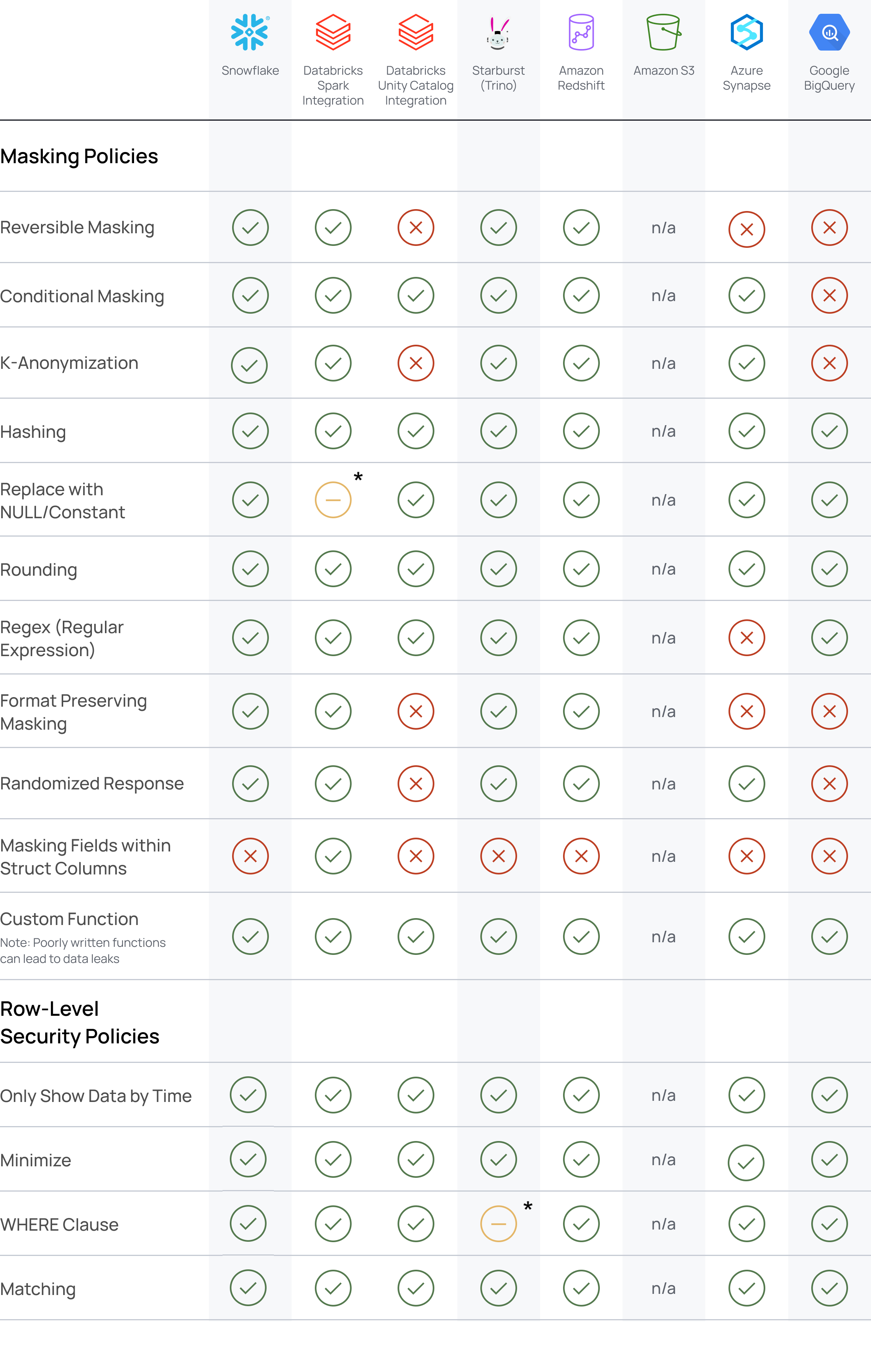
Certain policies are unsupported or supported with caveats\*, depending on the integration:

<figure><img src="https://1279220422-files.gitbook.io/~/files/v0/b/gitbook-x-prod.appspot.com/o/spaces%2F0QkDA8tcaDNby4bsGLcg%2Fuploads%2Fgit-blob-132d7b4f17bd0cad7770d037740111779b7db863%2Fpolicy-support-matrix.png?alt=media" alt=""><figcaption></figcaption></figure>

\*Supported with Caveats:

* On Databricks data sources, joins will not be allowed on data protected with replace with NULL or constant policies.
* On Starburst data sources, the `@iam` interpolation function can block the creation of a view.

For details about each of these policies, see the [Policies in Immuta page](https://documentation.immuta.com/2024.2/secure-your-data/authoring-policies-in-secure/policies-explained).

## Audit support for platform queries

The table below outlines what information is included in the query audit logs for each integration where query audit is supported.

<table data-full-width="false"><thead><tr><th></th><th>Snowflake</th><th>Databricks Spark</th><th>Databricks Unity Catalog</th><th>Starburst (Trino)</th></tr></thead><tbody><tr><td>Table and user coverage</td><td>Registered data sources and users</td><td>Registered data sources and users</td><td>All tables and users</td><td>Registered data sources and users</td></tr><tr><td>Object queried</td><td><span data-gb-custom-inline data-tag="emoji" data-code="2705">✅</span></td><td><span data-gb-custom-inline data-tag="emoji" data-code="2705">✅</span></td><td><a data-footnote-ref href="#user-content-fn-1">Limited support</a></td><td><span data-gb-custom-inline data-tag="emoji" data-code="2705">✅</span></td></tr><tr><td>Columns returned</td><td><span data-gb-custom-inline data-tag="emoji" data-code="2705">✅</span></td><td><span data-gb-custom-inline data-tag="emoji" data-code="274c">❌</span></td><td><span data-gb-custom-inline data-tag="emoji" data-code="274c">❌</span></td><td><span data-gb-custom-inline data-tag="emoji" data-code="2705">✅</span></td></tr><tr><td>Query text</td><td><span data-gb-custom-inline data-tag="emoji" data-code="2705">✅</span></td><td><span data-gb-custom-inline data-tag="emoji" data-code="2705">✅</span></td><td><a data-footnote-ref href="#user-content-fn-2">Limited support</a></td><td><span data-gb-custom-inline data-tag="emoji" data-code="2705">✅</span></td></tr><tr><td>Unauthorized information</td><td><a data-footnote-ref href="#user-content-fn-3">Limited support</a></td><td><span data-gb-custom-inline data-tag="emoji" data-code="2705">✅</span></td><td><a data-footnote-ref href="#user-content-fn-4">Limited support</a></td><td><span data-gb-custom-inline data-tag="emoji" data-code="274c">❌</span></td></tr><tr><td>Policy details</td><td><span data-gb-custom-inline data-tag="emoji" data-code="274c">❌</span></td><td><span data-gb-custom-inline data-tag="emoji" data-code="2705">✅</span></td><td><span data-gb-custom-inline data-tag="emoji" data-code="274c">❌</span></td><td><span data-gb-custom-inline data-tag="emoji" data-code="274c">❌</span></td></tr><tr><td>User's entitlements</td><td><span data-gb-custom-inline data-tag="emoji" data-code="274c">❌</span></td><td><span data-gb-custom-inline data-tag="emoji" data-code="2705">✅</span></td><td><span data-gb-custom-inline data-tag="emoji" data-code="274c">❌</span></td><td><span data-gb-custom-inline data-tag="emoji" data-code="274c">❌</span></td></tr><tr><td>Column tags</td><td><span data-gb-custom-inline data-tag="emoji" data-code="2705">✅</span></td><td><span data-gb-custom-inline data-tag="emoji" data-code="274c">❌</span></td><td><span data-gb-custom-inline data-tag="emoji" data-code="274c">❌</span></td><td><span data-gb-custom-inline data-tag="emoji" data-code="2705">✅</span></td></tr><tr><td>Table tags</td><td><span data-gb-custom-inline data-tag="emoji" data-code="2705">✅</span></td><td><span data-gb-custom-inline data-tag="emoji" data-code="274c">❌</span></td><td><span data-gb-custom-inline data-tag="emoji" data-code="274c">❌</span></td><td><span data-gb-custom-inline data-tag="emoji" data-code="274c">❌</span></td></tr></tbody></table>

**Legend**:

* :white\_check\_mark: This is available and the information is included in audit logs.
* :x: This is not available and the information is not included in audit logs.

[^1]: For some queries, Databricks Unity Catalog does not report the target data source for the data access operation. In these cases the activity is audited, yet the audit record in Immuta will not include the target data source information.

[^2]: Audit will return the `commandText` which often shows the query made.

[^3]: Unauthorized information is only available when the integration has table replacements enabled.

[^4]: Unauthorized queries will be audited when available.
