> For the complete documentation index, see [llms.txt](https://documentation.immuta.com/latest/llms.txt). Markdown versions of documentation pages are available by appending `.md` to page URLs; this page is available as [Markdown](https://documentation.immuta.com/latest/configuration/application-settings/how-to-guides/config-builder-guide.md).
# App Settings
Use the app settings page to configure your tenant
## Use Existing Identity Access Manager
See the [Identity managers documentation](/latest/configuration/people/section-contents.md#how-to-guides) for how-to guides for your IAM protocol.
## Set Default Permissions
To set the default permissions granted to users when they log in to Immuta, click the **Default Permissions** dropdown menu, and then select permissions from this list.
## Link External Catalogs
See the [External catalogs page](/latest/configuration/manage-data-metadata/catalogs/configure.md).
## Add a Workspace
1. Click the :gear: **App Settings** icon in the navigation menu.
2. Select **Add Workspace**.
3. Use the dropdown menu to select the **Workspace Type** and refer to the section below.
### **Databricks Spark**
{% hint style="info" %}
**Databricks cluster configuration**
Before creating a workspace, the cluster must send its configuration to Immuta; to do this, run a simple query on the cluster (i.e., `show tables`). Otherwise, an error message will occur when users attempt to create a workspace.
{% endhint %}
{% hint style="info" %}
**Databricks API Token expiration**
The **Databricks API Token** used for workspace access must be **non-expiring**. Using a token that expires risks losing access to projects that are created using that configuration.
{% endhint %}
Use the dropdown menu to select the **Schema** and refer to the corresponding tab below.
{% tabs %}
{% tab title="s3a" %}
{% hint style="info" %}
**Required AWS S3 Permissions**
When configuring a workspace using Databricks with S3, the following permissions need to be applied to `arn:aws:s3:::immuta-workspace-bucket/workspace/base/path/*` and `arn:aws:s3:::immuta-workspace-bucket/workspace/base/path` *Note: Two of these values are found on the App Settings page; `immuta-workspace-bucket` is from the **S3 Bucket** field and `workspace/base/path` is from the **Workspace Remote Path** field*:
* s3:Get\*
* s3:Delete\*
* s3:Put\*
* s3:AbortMultipartUpload
Additionally, these permissions must be applied to `arn:aws:s3:::immuta-workspace-bucket` *Note: One value is found on the App Settings page; `immuta-workspace-bucket` is from the **S3 Bucket** field*:
* s3:ListBucket
* s3:ListBucketMultipartUploads
* s3:GetBucketLocation
{% endhint %}
1. Enter the **Name**.
2. Click **Add Workspace**
3. Enter the **Hostname**.
4. Opt to enter the **Workspace ID** (required with Azure Databricks).
5. Enter the **Databricks API Token**.
6. Use the dropdown menu to select the **AWS Region**.
7. Enter the **S3 Bucket**.
8. Opt to enter the **S3 Bucket Prefix**.
9. Click **Test Workspace Bucket**.
10. Once the credentials are successfully tested, click **Save**.
{% endtab %}
{% tab title="abfss" %}
1. Enter the **Name**.
2. Click **Add Workspace**.
3. Enter the **Hostname**, **Workspace ID**, **Account Name**, **Databricks API Token**, and **Storage Container**.
4. Enter the **Workspace Base Directory**.
5. Click **Test Workspace Directory**.
6. Once the credentials are successfully tested, click **Save**.
{% endtab %}
{% tab title="gs" %}
1. Enter the **Name**.
2. Click **Add Workspace**.
3. Enter the **Hostname**, **Workspace ID**, **Account Name**, and **Databricks API Token**.
4. Use the dropdown menu to select the **Google Cloud Region**.
5. Enter the **GCS Bucket**.
6. Opt to enter the **GCS Object Prefix**.
7. Click **Test Workspace Directory**.
8. Once the credentials are successfully tested, click **Save**.
{% endtab %}
{% endtabs %}
## Add An Integration
### Integration settings
Follow the [Configure a Databricks Spark integration guide](/latest/configuration/integrations/databricks/databricks-spark/how-to-guides/configuration.md) to set up the integration.
### Global Integration Settings
#### Snowflake Audit Sync Schedule
**Requirements**: See the requirements for Snowflake audit on the [Snowflake query audit logs page](/latest/governance/detect-your-activity/audit/reference-guides/query-audit-logs/snowflake.md#requirements).
To configure the [audit ingest frequency for Snowflake](/latest/governance/detect-your-activity/audit/reference-guides/query-audit-logs/snowflake.md#audit-frequency),
1. Click the :gear: **App Settings** icon in the navigation menu.
2. Navigate to the **Global Integration Settings** section and within that the **Snowflake Audit Sync Schedule**.
3. Enter an integer into the textbox. If you enter 12, the audit sync will happen once every 12 hours, so twice a day.
#### Databricks Unity Catalog Configuration
**Audit**
**Requirements**: See the requirements for Databricks Unity Catalog audit on the [Databricks Unity Catalog query audit logs page](/latest/governance/detect-your-activity/audit/reference-guides/query-audit-logs/databricks-uc.md#requirement).
To configure the [audit ingest frequency for Databricks Unity Catalog](/latest/governance/detect-your-activity/audit/reference-guides/query-audit-logs/databricks-uc.md#audit-frequency),
1. Click the :gear: **App Settings** icon in the navigation menu.
2. Navigate to the **Global Integration Settings** section and within that the **Databricks Unity Catalog Configuration**.
3. Enter an integer into the textbox. If you enter 12, the audit sync will happen once every 12 hours, so twice a day.
**Additional privileges required for access**
By default, Immuta will revoke Immuta users' `USE CATALOG` and `USE SCHEMA` privileges in Unity Catalog for users that do not have access to any of the resources within that catalog/schema. This includes any `USE CATALOG` or `USE SCHEMA` privileges that were granted outside of Immuta.
To disable this setting,
1. Click the :gear: **App Settings** icon in the navigation menu.
2. Navigate to **Global Integration Settings** > **Databricks Unity Catalog Configuration**.
3. Click the **Revoke additional privileges required for access** checkbox to disable the setting.
4. Click **Save**.
See the [Databricks Unity Catalog protecting data reference guide](/latest/configuration/integrations/databricks/databricks-unity-catalog/databricks-unity-catalog-integration-reference-guide/protecting-data.md#user-permissions-immuta-revokes) for details about this setting.
## Manage Data Providers
You can enable or disable the types of data sources users can create in this section. Some of these types will require you to upload a driver before they can be enabled. The list of currently supported drivers is on the [ODBC Drivers page](/latest/configuration/application-settings/how-to-guides/odbc-drivers.md).
To enable a data provider,
1. Click the :gear: **App Settings** icon in the navigation menu and go to the **Data Providers** section.
2. Click the **menu** button in the upper right corner of the provider icon you want to enable.
3. Select **Enable** from the dropdown.
If a driver needs to be uploaded,
1. Click the **menu** button in the upper right corner of the provider icon, and then select **Upload Driver** from the dropdown.
2. Click in the **Add Files to Upload** box and upload your file.
3. Click **Close**.
4. Click the **menu** button again, and then select **Enable** from the dropdown.
## Enable Email
Application Admins can configure the SMTP server that Immuta will use to send emails to users. If this server is not configured, users will only be able to view notifications in the Immuta console.
To configure the SMTP server,
1. Click the :gear: **App Settings** icon in the navigation menu and go to the **Email** section.
2. Complete the **Host** and **Port** fields for your SMTP server.
3. Enter the username and password Immuta will use to log in to the server in the **User** and **Password** fields, respectively.
4. Enter the email address that will send the emails in the **From Email** field.
5. Opt to **Enable TLS** by clicking this checkbox, and then enter a test email address in the **Test Email Address** field.
6. Finally, click **Send Test Email**.
Once SMTP is enabled in Immuta, any Immuta user can request access to notifications as emails, which will vary depending on the permissions that user has. For example, to receive email notifications about group membership changes, the receiving user will need the `GOVERNANCE` permission. Once a user requests access to receive emails, Immuta will compile notifications and distribute these compilations via email at 8-hour intervals.
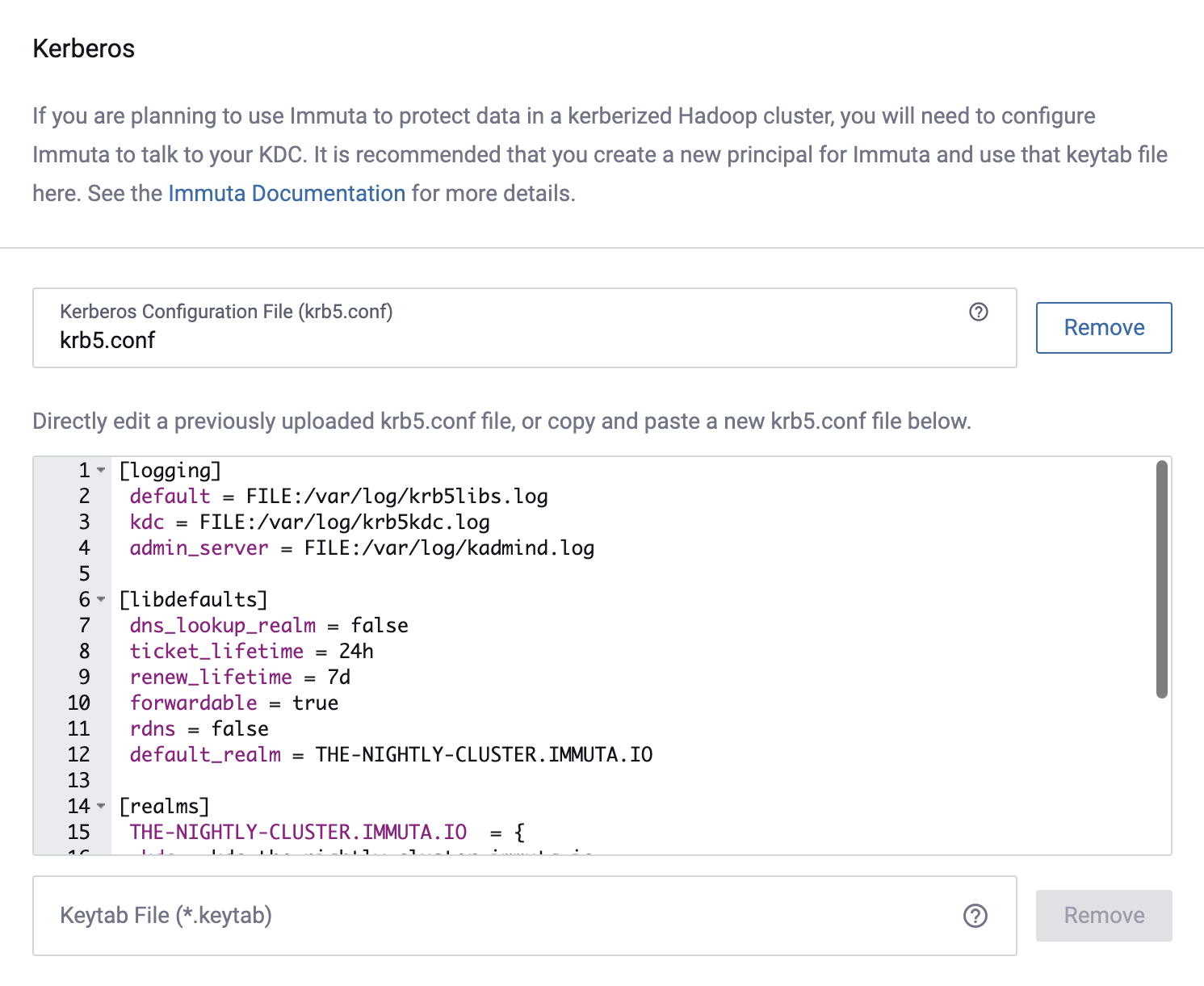
## Initialize Kerberos
To configure Immuta to protect data in a kerberized Hadoop cluster,
1. Click the :gear: **App Settings** icon in the navigation menu and go to the **Kerberos** section.
2. Upload your **Kerberos Configuration File**, and then you can modify the Kerberos configuration in the edit window.
3. Upload your **Keytab File**.
4. Enter the principal Immuta will use to authenticate with your KDC in the **Username** field. *Note: This must match a principal in the Keytab file.*
5. Adjust how often (in milliseconds) Immuta needs to re-authenticate with the KDC in the **Ticket Refresh Interval** field.
6. Click **Test Kerberos Initialization**.
## Generate System API Key
1. Click the :gear: **App Settings** icon in the navigation menu and go to the **System** **API Key** section.
2. Click the **Generate Key** button.
3. Save this API key in a secure location.
## Configure HDFS Cache Settings
To improve performance when using Immuta to secure Spark or HDFS access, a user's access level is cached momentarily. These cache settings are configurable, but decreasing the Time to Live (TTL) on any cache too low will negatively impact performance.
To configure cache settings,
1. Click the :gear: **App Settings** icon in the navigation menu and go to the **Cache Settings** section.
2. Enter the time in milliseconds in each of the **Cache TTL** fields.
## Set Public URLs
You can set the URL users will use to access Immuta Application. *Note: Proxy configuration must be handled outside Immuta.*
1. Click the :gear: **App Settings** icon in the navigation menu and go to the **Public URLs** section.
2. Complete the **Public Immuta URL** field.
3. Click **Save** and confirm your changes.
## Audit Settings
### Exclude Query Text from Audit Records
By default, query text is included in query audit events from Snowflake, Databricks, and Starburst (Trino).
When query text is excluded from audit events, Immuta will retain query event metadata such as the columns and tables accessed. However, the query text used to make the query will not be included in the event. This setting is a global control for all configured integrations.
To exclude query text from audit events,
1. Click the :gear: **App Settings** icon in the navigation menu.
2. Scroll to the **Audit** section.
3. Check the box to **Exclude query text from audit events**.
4. Click **Save**.
## Configure Governor and Admin Settings
These options allow you to restrict the power individual users with the GOVERNANCE and USER\_ADMIN permissions have in Immuta. Click the **checkboxes** to enable or disable these options.
## Create Custom Permissions
You can create custom permissions that can then be assigned to users and leveraged when building subscription policies. *Note: You cannot configure actions users can take within the console when creating a custom permission, nor can the actions associated with existing permissions in Immuta be altered.*
To add a custom permission, click the **Add Permission** button, and then name the permission in the **Enter Permission** field.
## Create Custom Data Source Access Requests
To create a custom questionnaire that all users must complete when requesting access to a data source, fill in the following fields:
1. Click the :gear: **App Settings** icon in the navigation menu and go to the **Custom Data Source Access Questions** section.
2. Click **Add Custom Question**.
3. Opt for the questionnaire to be required and fill in the following fields:
1. **Key**: Any unique value that identifies the question.
2. **Header**: The text that will display on reports.
3. **Label**: The text that will display in the questionnaire for the user. They will be prompted to type the answer in a text box.
## Create Custom Login Message
To create a custom message for the login page of Immuta,
1. Click the :gear: **App Settings** icon in the navigation menu and go to the **Login Message** section.
2. Enter text in the **Enter Login Message** box. *Note: The message can be formatted in markdown.*
3. Opt to adjust the **Message Text Color** and **Message Background Color** by clicking in these dropdown boxes.
## Prevent Automatic Table Statistics
{% hint style="warning" %}
**Without fingerprints, some policies will be unavailable**
These policies will be unavailable until a data owner manually generates a fingerprint for a Snowflake data source:
* Masking with format preserving masking
* Masking using randomized response
{% endhint %}
To disable the automatic collection of statistics with a particular tag,
1. Click the :gear: **App Settings** icon in the navigation menu and go to the **Prevent Automatic Table Statistics** section.
2. Use the **Select Tags** dropdown to select the tag(s).
3. Click **Save**.
### Randomized response
{% hint style="info" %}
**Support limitation**: This policy is only supported in Snowflake integrations.
{% endhint %}
When a randomized response policy is applied to a data source, the columns targeted by the policy are queried under a fingerprinting process. To enforce the policy, Immuta generates and stores predicates and a list of allowed replacement values that may contain data that is subject to regulatory constraints (such as GDPR or HIPAA) in Immuta's metadata database.
The location of the metadata database depends on your deployment:
* Self-managed Immuta deployment: The metadata database is located in the server where you have your external metadata database deployed.
* SaaS Immuta deployment: The metadata database is located in the AWS global segment you have chosen to deploy Immuta.
To ensure this process does not violate your organization's data localization regulations, you need to first activate this masking policy type before you can use it in your Immuta tenant.
1. Click the :gear: **App Settings** icon in the navigation menu.
2. Navigate to the **Other Settings** section and scroll to the **Randomized Response** feature.
3. Select the **Allow users to create masking policies using Randomized Response** checkbox to enable use of these policies for your organization.
4. Click **Save** and confirm your changes.
## New Tag Behavior
Use this setting to control if the system-managed **New** tags are applied to new objects found during object sync from connections.
1. Click the :gear: **App Settings** icon in the navigation menu.
2. Navigate to the **Other Settings** section and scroll to the **New Tag Behavior** feature.
3. Opt to enable **Mark newly discovered columns with a New tag** by checking the box.
4. Opt to enable **Mark newly discovered data sources with a New tag** by checking the box.
5. Click **Save** and confirm your changes.
## Advanced Settings
### Preview Features
If you enable any Preview features, provide feedback on how you would like these features to evolve.
#### Complex Data Types
1. Click the :gear: **App Settings** icon in the navigation menu.
2. Navigate to the **Advanced Settings** section, and scroll to the **Preview Features**.
3. Check the **Allow Complex Data Types** checkbox.
4. Click **Save**.
### Advanced Configuration
Advanced configuration options provided by the Immuta Support team can be added in this section. The configuration must adhere to the YAML syntax.
#### Update the Time to Webhook Request Timeouts
1. Click the :gear: **App Settings** icon in the navigation menu.
2. Expand the **Advanced Settings** section and add the following text to the **Advanced Configuration** to specify the number of seconds before webhook requests timeout. *For example use `30` for 30 seconds. Setting it to `0` will result in no timeout.*
```yaml
webhookIntegrationResponseTimeout: 30
```
3. Click **Save**.
#### Update the Audit Ingestion Expiration
1. Click the :gear: **App Settings** icon in the navigation menu.
2. Expand the **Advanced Settings** section and add the following text to the **Advanced Configuration** to specify the number of minutes before an audit job expires. *For example use `300` for 300 minutes.*
```yaml
plugins:
auditService:
ingestionJob:
expirationInMinutes: 300
```
3. Click **Save**.
---
# Agent Instructions
This documentation is published with GitBook. GitBook is the documentation platform designed so that both humans and AI agents can read, navigate, and reason over technical content effectively. Learn more at gitbook.com.
## Querying This Documentation
If you need additional information that is not directly available in this page, you can query the documentation by asking a question.
Perform an HTTP GET request on the following URL with the `ask` and `goal` query parameters:
```
GET https://documentation.immuta.com/latest/configuration/application-settings/how-to-guides/config-builder-guide.md?ask=&goal=
```
`ask` is the immediate question: it should be specific, self-contained, and written in natural language.
`goal` is what the user is ultimately trying to achieve, the reason they need the answer. Sharing it helps GitBook give you a better, more relevant answer. A goal is most helpful when it describes the outcome the user wants rather than restating the question. For example, with `ask=how do I create an API token`, a goal like `automate deployments from our CI pipeline` lets GitBook tailor the answer to that use case.
The response will contain a direct answer to the question and relevant excerpts and sources from the documentation.
Use this mechanism when the answer is not explicitly present in the current page, you need clarification or additional context, or you want to retrieve related documentation sections.